 Conao3 Notes
cpython-pep638: PEP 638 syntactic macros for Python, implemented in CPython 3.15.2
PEP 638 proposes syntactic macros for Python.
You write a macro in the form name!, and at compile time a function written in Python expands it and rewrites the AST.
I implemented this PEP in CPython 3.15.2. I added rules to the parser and one layer that hands the AST to a Python function before compilation, and with those two changes macros run in CPython itself.
The repository is conao3/cpython-pep638, and it stacks the implementation commits on the v3.15.2 tag of python/cpython. It derives from CPython, so it uses the same license, the PSF License Version 2, but it is my own experiment and has no connection to the CPython project.
Writing and using a macro
A macro processor is a Python function that you mark with a decorator from the macros module.
It receives the AST of the macro and returns the AST that replaces it.
# mymacros.py
import ast
import macros

@macros.macro_processor(macros.STMT_MACRO, 1, "finally")
def try_(node, finally_):
    return ast.Try(body=node.body, handlers=[], orelse=[],
                   finalbody=finally_.body)

@macros.macro_processor(macros.EXPR_MACRO, 1)
def quote(node):
    return ast.Constant(ast.unparse(node.args[0]))
try_ is a statement macro that takes the finally!: clause after it as its second argument, and quote is an expression macro that turns its argument expression into a source string.
In the code that uses the macros, from! imports the processors.
# main.py
from! mymacros import try_
from! mymacros import quote

def read(log):
    try_!:
        return quote!(a + b * c)
    finally!:
        log.append("closed")

log = []
print(read(log), log)
I run this with the python built from this repository.
$ ./python main.py
a + b * c ['closed']
quote!(a + b * c) became the string 'a + b * c', and try_! became a try statement with a finally clause.
Neither a nor b is defined, but the macro replaces the expression with a string before Python can evaluate it, so you get no error.
Macro syntax
A macro name is an identifier followed by ! with no space between them, and a keyword followed by !, such as from! or finally!, is also a macro name.
Statement macros take this form.
name! [引数] [import NAME] [as NAME] [: ブロック]An expression macro takes the form name!(引数), but the statement form takes precedence at the start of a line.
Inside an f-string, I kept the ! in f"{x!r}" as the conversion specifier.
There are three kinds of macro processors.
STMT_MACRO: A statement macro. It receives the indented block asbody.SIBLING_MACRO: A statement macro without a block. It receives the next statement in the same block asbody.EXPR_MACRO: An expression macro.
If you use a macro you haven't imported, compilation fails with a SyntaxError.
$ cat undefined.py
print(quote!(a + b))
$ ./python undefined.py
  File "/path/to/undefined.py", line 1
    print(quote!(a + b))
          ^^^^^^^^^^^^^
SyntaxError: macro quote! is not defined
The layer that expands macros
CPython parses the source into an AST and builds the symbol table and the bytecode from that AST, so I put macro expansion at the point where the compiler starts turning the AST into bytecode.
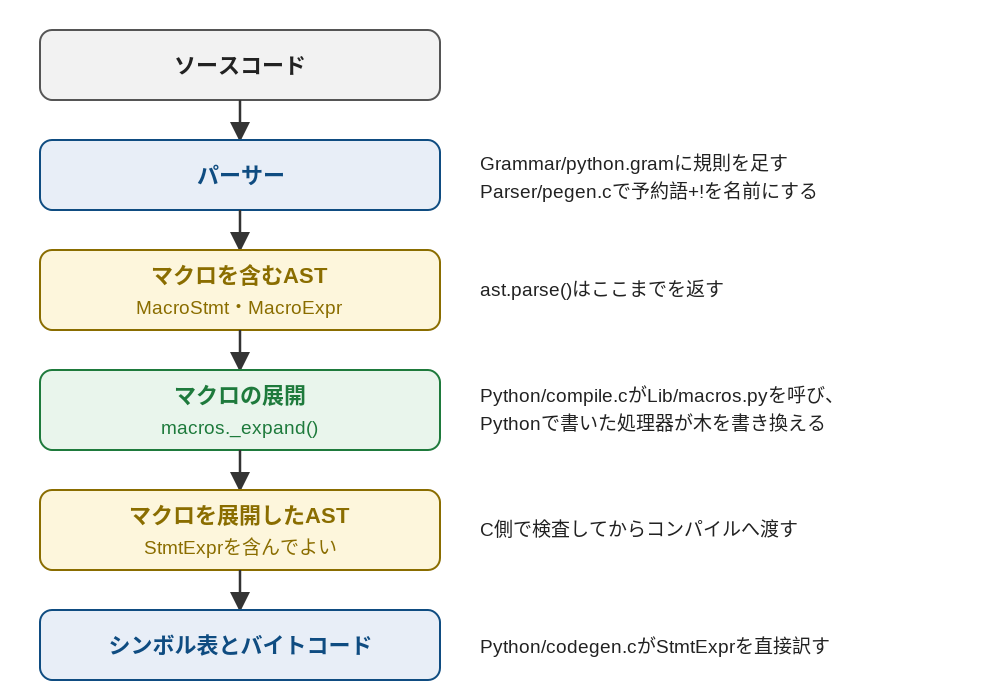
The parser keeps each macro in the tree as an ast.MacroStmt or ast.MacroExpr node, and the compiler walks the tree in C to look for macros.
If it finds one, it converts the tree into Python objects and passes them to macros._expand(), which calls the processors from the outermost macro inward and expands the trees those processors return as well.
The compiler converts the expanded tree back into C structs, validates it, and passes it on to the symbol table and bytecode generation.
Expansion runs on every compilation, so macros work through import, exec(), and compile() alike, and since ast.parse() returns the tree before expansion, you can inspect the macro nodes as the parser left them.
$ ./python -c 'import ast; print(ast.dump(ast.parse("quote!(a)").body[0]))'
MacroStmt(name='quote', args=[Name(id='a')])
quote!(a) sits at the start of the line, so the parser reads it as a statement macro.
A layer in front of the parser decides how to treat keywords.
CPython's parser receives finally as a keyword token and can't read finally! as a name, so when the next character is !, I made that layer skip the keyword check and keep the token as a name.
If != follows, as in x!=y, the parser reads it as the comparison operator.
StmtExpr: running a statement inside an expression
Some expression macros need to run a statement before they compute their value.
The PEP defines a stmt_expr node for this, and this implementation provides it as ast.StmtExpr(stmt, value), which runs stmt, then evaluates value and uses that as the value of the expression.
A new AST node called
stmt_exprwill be added, combining a statement and an expression. This new ast node will be a subtype ofexpr, but include a statement to allow side effects. It will be compiled to bytecode by compiling the statement, then compiling the value.
As a test, I write debug!, which prints an expression and its value and then returns the value.
# mymacros.py に足す
@macros.macro_processor(macros.EXPR_MACRO, 1)
def debug(node):
    tmp = f"$$debug_{node.lineno}_{node.col_offset}"
    label = ast.unparse(node.args[0]) + " ="
    show = ast.If(ast.Constant(True), [
        ast.Assign([ast.Name(tmp, ast.Store())], node.args[0]),
        ast.Expr(ast.Call(ast.Name("print", ast.Load()),
                          [ast.Constant(label), ast.Name(tmp, ast.Load())],
                          [])),
    ], [])
    return ast.StmtExpr(show, ast.Name(tmp, ast.Load()))
For the debug! on line 3 of debug.py, the variable name becomes $$debug_3_11.
This follows the naming that the PEP recommends to avoid collisions, and you can't write such a name in source code, so it can't clash with your variables.
- All generated variable names should start with a
$- Purely artificial variable names should start
$$mnamewheremnameis the name of the macro.- Variables derived from real variables should start
$vnamewherevnameis the name of the variable.- All variable names should include the line number and the column offset, separated by an underscore.
# debug.py
from! mymacros import debug

squares = [debug!(x * x) for x in range(3)]
print(squares)
print(True or debug!(1 / 0))
$ ./python debug.py
x * x = 0
x * x = 1
x * x = 4
[0, 1, 4]
TruePython evaluates debug! where it sits, both inside the comprehension and on the right of or, and it skips the right side of True or ..., so 1 / 0 doesn't run and stop the program.
The compiler translates StmtExpr into bytecode itself, so the statement runs where you place the macro, in Python's evaluation order.
If a break, continue, or return inside stmt leaves the StmtExpr, control jumps out in the middle of an expression and leaves values on the stack, so the compiler rejects such a tree with a SyntaxError.
# escape.py
import ast

tree = ast.parse("for x in y:\n    f(E)\n")
call = tree.body[0].body[0].value
call.args[0] = ast.StmtExpr(ast.Break(), ast.Constant(None))
ast.fix_missing_locations(tree)
compile(tree, "<ast>", "exec")
$ ./python escape.py
Traceback (most recent call last):
File "/path/to/escape.py", line 7, in <module>
compile(tree, "<ast>", "exec")
~~~~~~~^^^^^^^^^^^^^^^^^^^^^^^
File "<ast>", line 2
SyntaxError: 'break', 'continue' and 'return' cannot leave a statement expressionDifferences from the PEP
This implementation differs from the text of the PEP in these ways.
- The AST class names follow CPython's naming:
MacroStmt,MacroExpr, andStmtExpr. - The parser reads the block of a statement macro as Python statements. A line such as
"red" = 1in the PEP's bijection! example is a syntax error. - The PEP specifies the macro name as a single
MACRO_NAMEtoken, buttokenizereturns it as two tokens,NAMEand!. - The PEP defines the
versionof a processor as the number that lets Python rebuild cached bytecode correctly. This implementation checks thatversionis an integer, but it doesn't rebuild cached bytecode when you change a processor.
The bijection! example in the PEP looks like this.
bijection! color_to_code, code_to_color:
    "red" = 1
    "blue" = 2
    "green" = 3
Trying it
You build it the same way as CPython, and with Nix, nix develop nixpkgs#python315 gives you everything the build needs.
$ git clone https://github.com/conao3/cpython-pep638
$ cd cpython-pep638
$ ./configure --with-pydebug
$ make -j
$ ./python -m test test_macros
All 32 tests in test_macros pass, and the full CPython test suite passes as well, except for one test in test_profiling that checks the executable name of a child process and fails in the Nix environment.
The Where the implementation lives section of the repository README lists what I added and where.