 Conao3 Notes
emacsclient on NixOS: run Emacs as a server with services.emacs
As an Emacs user, you sometimes want to edit a file from the shell in the Emacs instance that is already running, and emacsclient lets you do that. This post sets up emacsclient on NixOS with services.emacs.
You keep Emacs running as a server, and emacsclient connects to it as a client and opens the file at once.
ref: nixpkgs/nixos/modules/services/editors/emacs.md at master / NixOS/nixpkgs / GitHub
How emacsclient works
Emacs supports a server/client model. Started the usual way, Emacs runs as a standalone process, but in server mode it stays resident in the background.
The emacsclient command then connects to the running Emacs server and opens files in a new frame or buffer.
Test environment
So that you can try this without NixOS, I set up a Nix flake that boots a NixOS VM on QEMU.
If you already use NixOS, add the settings to your own configuration.nix instead.
The VM has a minimal Xfce desktop, which is enough to try the server and client features of Emacs.
flake.nix
{
  inputs.nixpkgs.url = "github:nixos/nixpkgs/nixos-unstable";

  outputs = { self, nixpkgs }: {
    nixosConfigurations.minimal-vm = nixpkgs.lib.nixosSystem {
      system = "x86_64-linux";
      modules = [ ./configuration.nix ];
    };

    packages.x86_64-linux.default = self.nixosConfigurations.minimal-vm.config.system.build.vm;
  };
}
configuration.nix
{ modulesPath, pkgs, ... }: {
  imports = [ (modulesPath + "/virtualisation/qemu-vm.nix") ];

  system.stateVersion = "24.11";

  users.users.demo = {
    isNormalUser = true;
    extraGroups = [ "wheel" ];
    initialPassword = "demo";
  };

  services.xserver.enable = true;
  services.xserver.desktopManager.xfce.enable = true;
  services.xserver.desktopManager.xfce.enableScreensaver = false;

  environment.systemPackages = with pkgs; [ git ];
}
With these two files in place, this command boots the VM.
QEMU_OPTS="-m 8192 -smp 4" nix run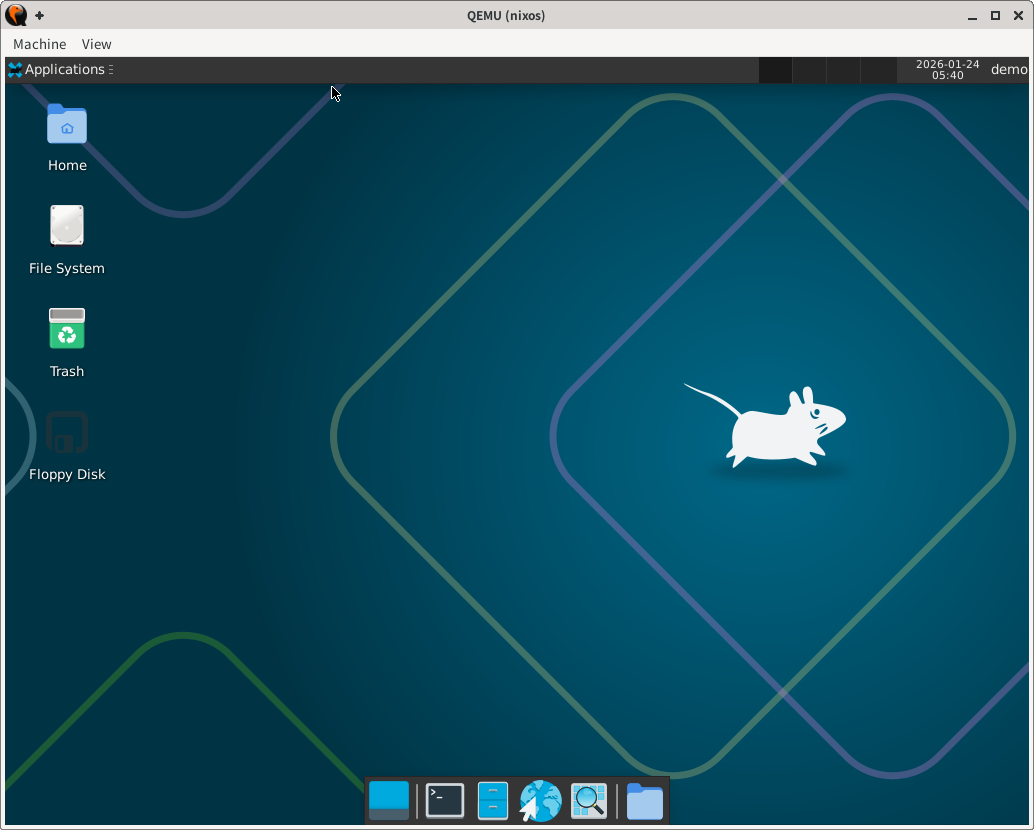
From here on, you make your changes in configuration.nix.
Configuration
Enabling services.emacs starts the Emacs server when the user logs in.
configuration.nix
{
  services.emacs = {
    enable = true;
    defaultEditor = true;
  };
}
NixOS turns this setting into the systemd user service emacs, which runs emacs --fg-daemon when you log in to the desktop.
Setting defaultEditor as well points EDITOR at emacsclient, so programs that use EDITOR open files in emacsclient without any setup of their own.
The option only sets an environment variable, so if you let e run EDITOR, e something.txt opens the file.
{
  environment.shellAliases = {
    e = "$EDITOR";
  };
}
services.emacs options
services.emacs has a few more useful options.
package
This option selects the Emacs package to use.
The default is pkgs.emacs, and you can also set emacs-nox, emacs-pgtk, or an Emacs package you customized yourself.
{
  services.emacs = {
    enable = true;
    package = pkgs.emacs-pgtk;
  };
}
Usage
After login
The Emacs server starts when you log in to the desktop, so emacsclient can open a new frame right away.
Earlier you made e an alias for $EDITOR, so running e alone opens a new frame.
Add & so the command doesn't block the shell.
e &You can also run emacsclient -c yourself.
emacsclient -c &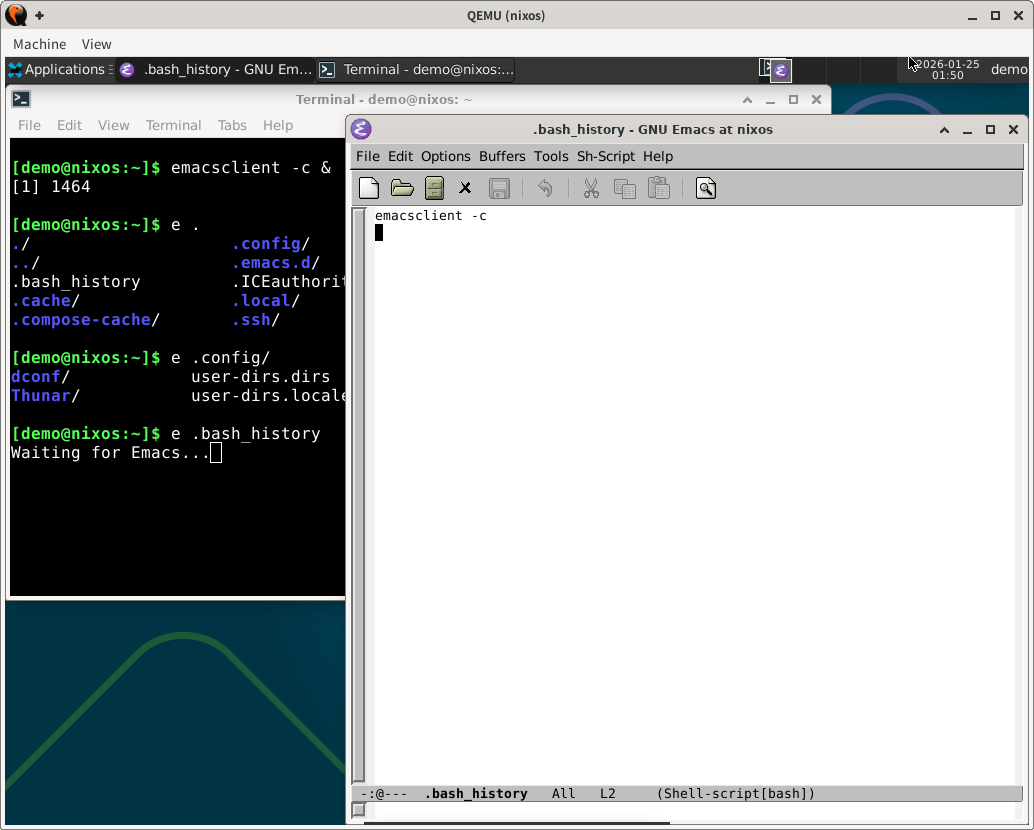
Opening a file
In the same way, e something.txt opens a file.
To give control back to the shell, press C-x # and tell Emacs you have finished editing.
e something.txtMain emacsclient options
-c (--create-frame)
Creates a new frame and opens the file in it.
e -c file.txt-t (--tty)
Opens Emacs inside the terminal.
e -t file.txt-n (--no-wait)
Gives control back to the shell as soon as the file opens. By default emacsclient waits until you finish editing, and with this option it opens the file in the background.
e -n file.txtChecking the server status
Use systemctl to check that the Emacs server is running.
systemctl --user status emacsTo restart the server by hand:
systemctl --user restart emacsTroubleshooting
The server doesn't start
Check the log first.
journalctl --user -u emacsIn most cases, an error in your Emacs init file (init.el) causes this. Start Emacs the usual way, fix the configuration, and then restart the server.
Several servers are running
If several Emacs servers end up running for some reason, these commands stop all of them.
systemctl --user stop emacs
pkill -u $USER emacs
Then start the server again.
systemctl --user start emacsSharing the clipboard
To use text you copied in the QEMU VM on the host as well, use the GTK backend of QEMU.
Add -display gtk to QEMU_OPTS when you boot the VM:
QEMU_OPTS="-m 8192 -smp 4 -display gtk" nix runText you copy inside the VM then shows up in the clipboard of the host.
tips
It's fun to look at what this configuration sets up.
Check the systemd unit file:
systemctl --user cat emacsCheck the value of the EDITOR environment variable:
$ echo $EDITOR
emacseditor

$ which $EDITOR
/run/current-system/sw/bin/emacseditor

$ cat $(which $EDITOR)
#!/nix/store/lw117lsr8d585xs63kx5k233impyrq7q-bash-5.3p3/bin/bash
if [ -z "$1" ]; then
  exec /nix/store/3gh804i02baai4yvn4vz99hs4ncvxjdd-emacs-30.2/bin/emacsclient --create-frame --alternate-editor /nix/store/3gh804i02baai4yvn4vz99hs4ncvxjdd-emacs-30.2/bin/emacs
else
  exec /nix/store/3gh804i02baai4yvn4vz99hs4ncvxjdd-emacs-30.2/bin/emacsclient --alternate-editor /nix/store/3gh804i02baai4yvn4vz99hs4ncvxjdd-emacs-30.2/bin/emacs "$@"
fi
You can see that EDITOR runs emacseditor, a small shell script that wraps emacsclient.
Summary
With services.emacs on NixOS, setting up emacsclient takes little effort.
If you have wanted to use emacsclient but couldn't get the setup to work, give this a try.