 Conao3 Notes
Fun new features in the Emacs development version, shown in screenshots
I picked new features from the NEWS of the Emacs development version (master, which will become Emacs 32) that you notice the moment you use them, and this post shows each one in a screenshot. The highlights are regexp matching in time proportional to the input length, and a preview while you type a replacement.
The development NEWS grows in etc/NEWS on master, and at caf462d (2026-11-26), the commit I used, it runs to 871 lines. The Emacs 31.1 NEWS has 4,274 lines, so master is about a fifth of the way there.
I will add to this post as new features land on master, and when Emacs 32.1 comes out I will retitle it as the Emacs 32 post.
The version I tried
I built master with emacs-git from nix-community's emacs-overlay.
nix build github:nix-community/emacs-overlay/ff3361a80b6e0f5a51ddf6e43525125d5a3a7f97#emacs-gitemacs --version prints GNU Emacs 32.0.50, and emacs-repository-version is caf462d.
I took every screenshot in Emacs started with emacs -Q, and I include the code for each feature that needs a setting.
Regexps match in time proportional to the input
The regexp engine now matches in linear time. The old engine backtracks, so a regexp with many ways to match could take exponential time and make Emacs look frozen.
I timed a regexp that repeats a or aa and then expects b, against strings of a only.
;;; regex-bench.el  -*- lexical-binding: t -*-
(dolist (n '(24 28 32 36))
  (let* ((s (make-string n ?a))
         (start (float-time)))
    (string-match "\\(?:a\\|aa\\)*b" s)
    (message "%2d chars: %8.3f s" n (- (float-time) start))))
$ emacs --batch -Q -l regex-bench.el # Emacs 31.1
24 chars: 0.018 s
28 chars: 0.123 s
32 chars: 0.885 s
36 chars: 5.902 s
$ emacs --batch -Q -l regex-bench.el # Emacs 32.0.50 (caf462d)
24 chars: 0.000 s
28 chars: 0.000 s
32 chars: 0.000 s
36 chars: 0.000 sIn Emacs 31.1 every four more characters cost about seven times as much, and 36 characters took almost 6 seconds.
The development version finished every length in under a millisecond.
The NEWS lists exceptions: regexps with backreferences or \{N,M\} repetition can still take exponential time.
Preview a replacement while you type it
Set query-replace-show-preview, and while you type the replacement for M-%, the matches visible in the window show how they will look after the replacement.
(setopt query-replace-show-preview 'both)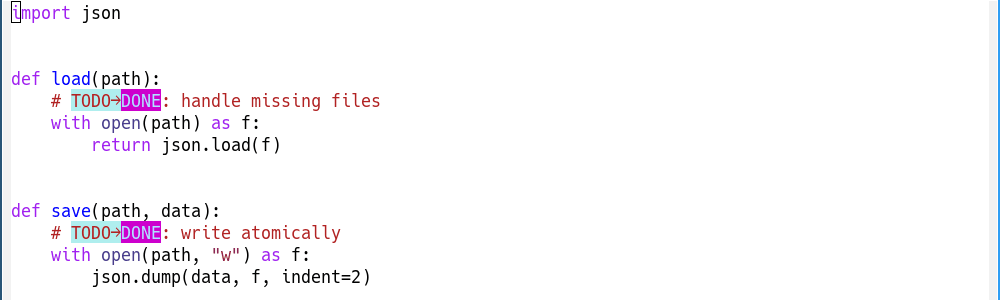
Here I typed M-% TODO RET and then DONE, and both TODO comments show TODO→DONE.
both shows the match and the replacement side by side, and replacement-only shows the replacement alone.
You see what will change, in place, before the replacement starts.
Tell keys such as C-S-a apart in a terminal
When your terminal emulator supports the Kitty Keyboard Protocol, emacs -nw reads keys through it.
Key chords that only the GUI could tell apart become separate keys in a terminal too.
I ran emacs -nw in foot, typed C-h k, and pressed C-S-a in both versions.

Emacs 31.1 receives C-S-a as C-a.
The development version receives C-S-a as it is, as the GUI does, and then translates it to C-a.
Bind a command to C-S-a, and you can use both keys in a terminal.
Fold comment headings with Outline and list them
Set outline-use-comment-regexp to t, and outline-minor-mode treats lines that start with a comment, such as ;;; * and ;;; **, as headings.
The number of stars sets the heading level.
(setopt outline-use-comment-regexp t)
(add-hook 'emacs-lisp-mode-hook #'outline-minor-mode)
outline-find-headings lists every heading of the buffer in an Xref buffer.
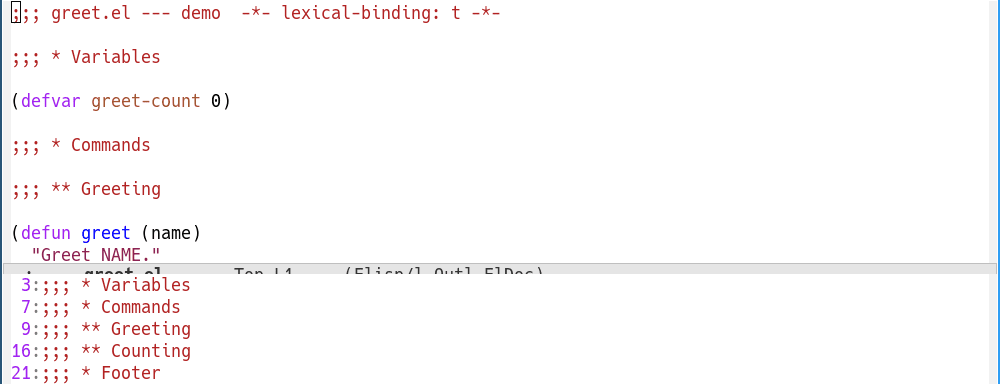
The top window is an Emacs Lisp file, and the bottom one is the heading list from outline-find-headings.
Pick a line in the list to jump to that heading.
Rename an identifier and check the diff before applying it
refactor is a library that runs refactorings such as renaming an identifier or extracting a function with the same commands in any language. It was extracted from Eglot, and Eglot hands the language server's refactorings to it.
I connected Eglot to pylsp in a Python file and typed M-x refactor-rename RET load_json RET on the function load.
With refactor-confirmation set to diff, the changes do not apply right away and show up as a diff in the *refactor changes* buffer.
(setopt refactor-confirmation 'diff)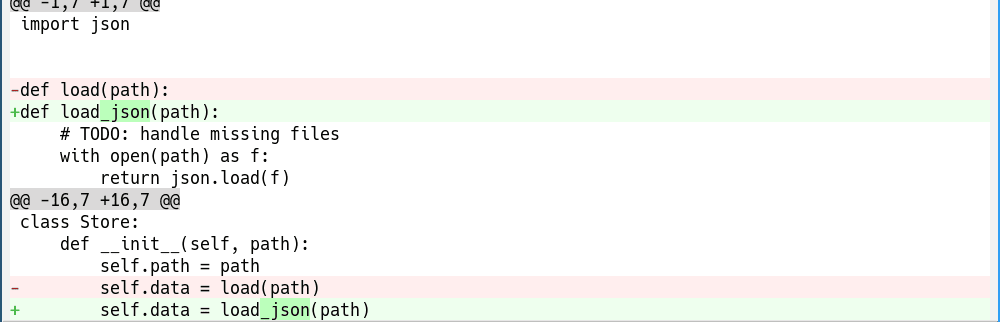
The definition def load and the call load(path) become load_json, and json.load(f) keeps its name because the language server knows it is a different function.
After checking the diff, C-c C-a applies one hunk and C-c RET a applies them all.
Convert between numbers and Roman numerals
number-to-roman and roman-to-number are now autoloaded functions you can call from anywhere.
;;; roman.el  -*- lexical-binding: t -*-
(message "%s" (number-to-roman 2026))
(message "%s" (roman-to-number "XXXII"))
$ emacs --batch -Q -l roman.el
MMXXVI
32Other changes worth a look
- canvas images are made for fast redraws: you rewrite the pixel data and call
canvas-refresh. On Cairo builds they have been drawn black or as broken patterns since c9f0656d47 landed on 2026-11-21, and the caf462d build shows this in both the X11 and the pgtk version. I reported it in Bug#79204, and I will add a section once it is fixed. - uuid is a library that generates and parses UUIDs.
- Emacs supports Unicode 18.0.
New features from Emacs 27 to the development version
I wrote one post in the same format for each Emacs release from 27 to the development version.